Google Ads AI Max Becomes Default on September 1
Starting September 1, 2026, Google will automatically upgrade Search campaigns to AI Max if they use either automatically created assets or the campaign-level broad match setting. If your campaigns use neither, nothing happens. If they use one or both, features get switched on for you unless you act first.
Google emailed affected advertisers in early August. If you got that email, this applies to you. If you didn't, it's still worth checking, because the trigger is a campaign setting rather than an account-level opt-in and it's easy to have one campaign using it without remembering.
What actually gets turned on
The upgrade isn't one-size-fits-all. What you end up with depends on which setting triggered it.
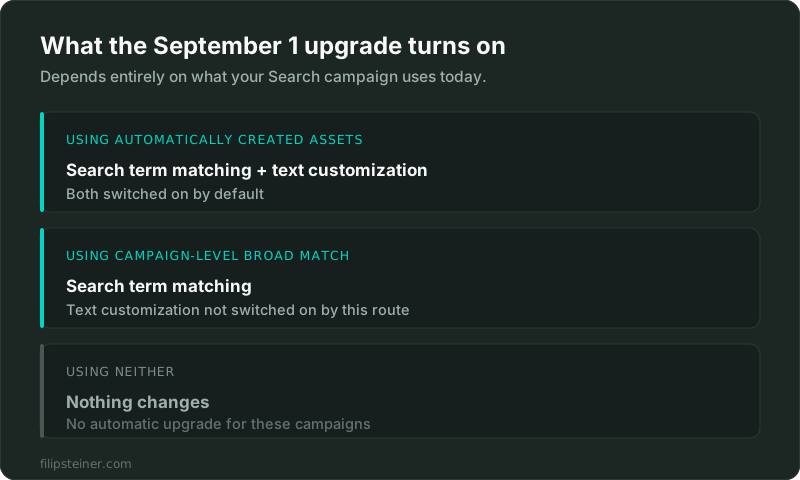
- Campaigns using automatically created assets get AI Max with search term matching and text customization enabled.
- Campaigns using the campaign-level broad match setting get AI Max with search term matching enabled.
- Campaigns using neither are not upgraded.
Google's framing is that this mirrors your current configuration rather than expanding it, since automatically created assets and text customization do broadly similar jobs, as do campaign-level broad match and search term matching. That's a fair description of the intent. Whether it behaves identically in your account is the part worth verifying yourself.
What AI Max actually is
AI Max isn't a new campaign type. It's a bundle of three features that sit on top of a standard Search campaign:
- Search term matching expands beyond your keywords using broad match and keywordless technology, to reach queries your keyword list wouldn't have caught.
- Text customization rewrites and tailors headlines and descriptions based on the query and the user.
- Final URL expansion sends people to whichever page on your site Google judges most relevant, instead of the final URL you set.
Note that the auto-upgrade only enables the first two, depending on your trigger. Final URL expansion is part of AI Max but isn't described as part of what gets switched on automatically. Worth confirming in your own settings after the upgrade rather than assuming either way.
What you keep control of
This is the part that gets lost in the "Google is taking over your account" reaction. AI Max keeps a real set of controls:
- Brand exclusions, so you decide which brands you do and don't want to appear for.
- Locations of interest, on top of standard location targeting.
- URL inclusions and exclusions, which matter a lot if final URL expansion is on. You can keep it away from your blog, your careers page, or anything else that isn't a landing page.
- Text guidelines, including term exclusions and messaging restrictions, so text customization stays inside your brand voice.
- Search terms reporting, so you can still see what queries you're actually paying for.
That last one is the important one. The main risk with looser matching is paying for queries that were never going to convert, and the search terms report is how you catch that. It doesn't go away.
What to do before September 1
You have three options, and doing nothing is one of them.
- Let it happen, then audit. Reasonable if your account is well built and you're watching it. Diarise the date, then check search terms and cost per conversion in the weeks after.
- Turn AI Max on yourself, now. This is the option I'd pick for most accounts. You get the same features, but you choose the settings and you can watch the change land on a date you controlled, rather than one Google picked.
- Turn off the trigger setting. If you switch off automatically created assets or campaign-level broad match before September 1, the campaign isn't upgraded. Useful if you have a specific reason to keep those campaigns as they are.
Whichever you choose, do these two things first:
- Note the date in your account annotations. When you're comparing September to August, you'll want to know exactly where the line is. Same advice as the bid target enforcement change on August 17, and for the same reason.
- Record your current baseline. Cost per conversion, conversion rate, and search terms for the last 28 days. Without that, you can't tell afterwards whether anything actually changed.
If you'd rather someone just checked which of your campaigns are affected and what to do about each one, that's a quick job and I'm happy to do it.
Should you actually be worried?
Honestly, it depends on how tightly your account is built.
If you're running exact and phrase match with a well-maintained negative keyword list, and you deliberately avoided broad match, then looser matching is a real change in behaviour and you should treat it seriously. Test it rather than accept it by default.
If you're already running campaign-level broad match and automatically created assets, you've effectively opted into this way of working already. The upgrade is closer to a rename than a reinvention, and the practical impact should be small.
The scenario I'd watch most closely is a small local account with a modest budget and a narrow service area. Broader matching on a small budget can pull spend toward loosely related queries fast, and there's less room to absorb that than in a large account. If that's you, options 2 or 3 above are worth the hour.
One more thing worth saying plainly: Google's own figure for AI Max is 14% more conversions at a similar CPA or ROAS, from its internal data on non-retail advertisers in 2025. That's a vendor statistic about its own product, not an independent result, and it's an average across accounts that look nothing like each other. It's a reason to test, not a reason to assume.
Frequently asked questions
What is AI Max in Google Ads? It's a set of features for Search campaigns, not a new campaign type. It combines search term matching, text customization of headlines and descriptions, and final URL expansion.
Which campaigns are being upgraded on September 1, 2026? Search campaigns using automatically created assets, or the campaign-level broad match setting, or both. Campaigns using neither are not affected.
Can I stop my campaigns being upgraded to AI Max? Yes. Turning off automatically created assets or the campaign-level broad match setting before September 1 removes the trigger. You can also enable AI Max yourself beforehand so you control the configuration.
Does AI Max replace my keywords? No. Search term matching expands beyond your keyword list rather than replacing it, and your existing keywords and match types stay in the campaign.
Will AI Max change my ad copy? If text customization is enabled, yes, headlines and descriptions can be tailored automatically. Text guidelines and term exclusions let you constrain what it's allowed to say.
Can I still see which search terms I paid for? Yes. The search terms report still works, and it's the main thing to watch after the upgrade lands.
Google's own documentation is About AI Max for Search campaigns.
If you'd rather not spend September watching your account for surprises, Google Ads management is exactly that job. And if you just want to know whether your account is in good shape before this lands, a PPC account audit will tell you.
Questions about how this affects your account?
Let's talk